
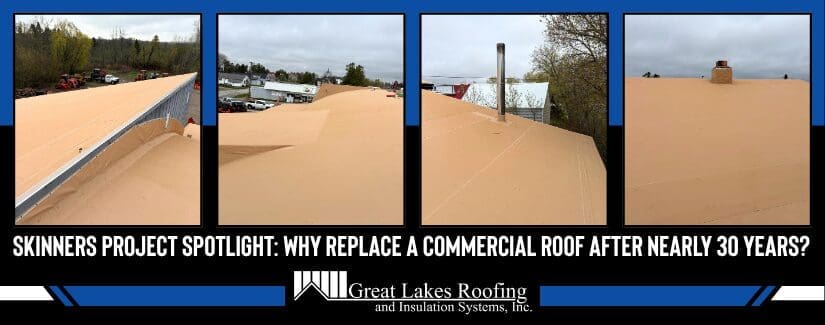
When we returned to Skinners in Pickford, Michigan, in 2026, we were working on a roof with a history we knew firsthand. Our team had installed the previous roofing system in the mid-1990s, returned to inspect it in 2017, and was ultimately called back when age led Skinners to move forward with replacement. We completed a full tear-off of the 12,243-square-foot roof and installed a new mechanically attached 50 mil Duro-Last® PVC roofing system in two weeks while the business remained open.
On This Page
- Returning to a Roof We Installed Nearly 30 Years Ago
- Challenge: Age Led to the Roof Replacement
- A Barrel Roof Made This Building Different
- Solution: Starting With a Complete Tear-Off
- Installing the New Duro-Last PVC Roof
- What We Found Beneath the Existing Roof
- Completing the Project While Skinners Stayed Open
- Results: A New Roof in Two Weeks
- Why Skinners Called Us Back
- What This Project Shows Building Owners
Returning to a Roof We Installed Nearly 30 Years Ago
Replacing a roof our own team installed decades earlier brings a different perspective. We knew the history of the Skinners roof because our involvement with the building went back to the mid-1990s, when we installed the previous roofing system.
We returned in 2017 to inspect the roof and provide Skinners with an updated inspection report and recommendations. By 2026, age had become the reason for moving forward with a complete roof replacement.
Skinners is a retail business in Pickford, Michigan, that sells and repairs new and used equipment. Its 12,243-square-foot roof is also somewhat unusual compared with many of the low-slope commercial roofs we work on because the majority of the building has a barrel roof configuration.
For us, the 2026 project meant returning to a familiar building to remove the roof we had installed nearly three decades earlier and put the next roofing system in place.
Challenge: Age Led to the Roof Replacement
Not every commercial roof replacement begins with a storm, a major leak, or a sudden failure. At Skinners, the reason was much simpler. The existing roofing system had been in place since the mid-1990s, and age ultimately led to the decision to replace it.
That history gave Skinners something building owners do not always have: a known installation timeline. There was no need to estimate when the existing roof had been installed or piece together its history from incomplete records. We had installed it ourselves and had returned in 2017 to inspect it.
Age alone, however, should not be treated as a universal replacement rule for every commercial roof. Two roofs of similar age can have very different conditions depending on their assemblies, exposure, maintenance history, previous repairs, rooftop activity, and other building-specific factors. The appropriate decision should come from the condition of the roof being evaluated, not from a calendar alone.
In this case, Skinners benefited from a documented roof history and an existing relationship with our team. When it came time to replace the aging system, the project moved forward as a complete tear-off rather than another repair.
A Barrel Roof Made This Building Different
The barrel shape matters because membrane roofing still has to follow the geometry of the building beneath it. The photographs from the completed project show the Duro-Last membrane following that curved roof profile, along with transitions into adjoining roof areas and vertical details.

One of the first things visible in the project photographs is the roof’s shape. Most of the Skinners roof has a barrel configuration, creating a broad curved surface rather than the predominantly flat plane commonly associated with commercial membrane roofing.
Solution: Starting with a Complete Tear-Off
The replacement began by removing the existing membrane roofing system. Instead of recovering the old roof with another membrane, our scope called for a complete tear-off.
Removing the existing roofing exposed the assembly beneath it. The assembly included both wood and metal decking, along with 2 inches of existing insulation. Once the tear-off was complete, the crew could see whether any of those underlying components needed additional work before installing the new roof. In this case, they did not.
There was no wood or metal decking that needed to be repaired or replaced. The project also included no repairs or replacements to the existing insulation, drains, or other roof components. No new insulation was installed, and the replacement did not include a cover board.
That kept the completed scope straightforward. The old membrane came off, the underlying components did not require additional repairs, and the new roofing system could be installed over the existing assembly.
Installing the New Duro-Last PVC Roof
With the old roofing removed and the existing assembly ready for reroofing, we installed 50 mil Duro-Last PVC deck sheets using a mechanically attached application. Calling it a Duro-Last roof tells only part of the story, since the system can be installed with different membrane thicknesses and attachment methods. At Skinners, we installed 50 mil Duro-Last deck sheets using a mechanically attached system.
Building owners researching the system can learn more in our blog article about Duro-Last single-ply PVC roofing and how we use PVC roofing for commercial buildings.
Here is the completed project scope at a glance:
Project Detail: Skinners Roof Replacement
| Location | Pickford, Michigan |
| Building Use | Retail, equipment sales and repairs |
| Roof Area | 12,243 sq. ft |
| Roof Configuration | Majority barrel roof |
| Reason for Replacement | Age |
| Replacement Scope | Complete tear-off |
| New Roofing System | Duro-Last PVC |
| Membrane | 50 mil deck sheets |
| Attachment | Mechanically attached |
| New Insulation | None |
| Cover Board | None |
| Deck Repairs | None |
| Drain Repairs | None |
| Project Duration | 2 weeks |
| Business Operation | Remained open |
| Warranty | 20-year NDL |
The specifications from one completed roof should not automatically be applied to another. Duro-Last offers multiple membrane thicknesses and attachment methods, and its specification system accounts for variables such as membrane type, attachment method, insulation, cover board, and existing roof deck. That means the roofing assembly must be defined for each project rather than assumed from another installation.
What We Found Beneath the Existing Roof
A tear-off can be a key part of a reroofing project because it provides direct access to conditions previously concealed by the roofing system. That does not mean every tear-off will uncover damaged decking or insulation, and the Skinners project is a good example.
After removing the existing roofing, the project team reported that the wood and metal decking did not require repair or replacement. They also reported no repairs to the existing insulation or drains.
With the existing roof removed, the underlying components were in suitable condition to remain in place. No deck replacement, new insulation, cover board, or drain repairs were needed, allowing our crew to move forward with the planned roof installation.
For a building owner preparing for a commercial roof replacement, this is also a useful reminder that the visible membrane is only one part of the existing assembly. Conditions beneath it can affect the work required once tear-off begins, which is why documenting what is known about the existing roof before construction can be valuable during project planning.
Completing the Project While Skinners Stayed Open
Skinners remained open throughout the two-week roof replacement, allowing business to continue while our crew completed the work. Every occupied building presents its own considerations, so factors such as access, rooftop equipment, staging areas, weather, safety requirements, and daily operations must be considered when planning a commercial roof replacement. Building owners facing more complicated operational requirements can read more about the planning involved in replacing a commercial roof without shutting down operations.

Results: A New Roof in Two Weeks
From tear-off through installation, the Skinners commercial roof replacement took two weeks to complete. The project was finished on schedule and within the planned budget while the business remained open.
The completed roof consists of mechanically attached 50 mil Duro-Last PVC deck sheets across the building’s 12,243-square-foot roof area. The project did not require new insulation, a cover board, deck repairs, or drain repairs, and the completed roofing system is backed by a 20-year NDL warranty.
The new Duro-Last PVC roofing system is backed by a 20-year NDL warranty. While a warranty doesn’t predict a roof’s exact service life, it gives Skinners defined coverage for the new system as they begin the next chapter with a building we first roofed nearly three decades ago.
Why Skinners Called Us Back
Our relationship with Skinners goes back to the mid-1990s, when we installed the building’s previous roof. We returned in 2017 to inspect the system and provide recommendations, and when age eventually led to replacement in 2026, Skinners called us again.
Happy with the first roof, Skinners trusted our team to handle the building’s next commercial roof replacement. Nearly three decades after our original installation, we completed the full tear-off and installed the new Duro-Last PVC roofing system, making this the second time Great Lakes Roofing has roofed the same building.
What This Project Shows Building Owners

The Skinners project is a useful example of how good roof history can inform a replacement decision. The owner knew when the existing roof was installed, had a documented inspection from 2017, and knew which contractor performed the original work. When age led to replacement, the owner had an established record to work from.
Building owners do not always inherit that level of information. Roof records can be incomplete, ownership can change, repairs may have been performed by several contractors, and the age or composition of an existing assembly may not be obvious from the surface. In those situations, the first question should not automatically be, “What should we replace it with?” It should be, “What do we know about the roof we have now?”
A commercial roof inspection can help establish current conditions before the owner decides what comes next. Depending on the findings, the appropriate path may involve maintenance, repair, further investigation, or replacement.
Skinners had nearly 30 years of history with its previous roof and with our team. When that roof reached the end of its useful life, we returned to remove it and install the next system. The result was a 12,243-square-foot mechanically attached Duro-Last PVC roof completed in two weeks, with the business remaining open throughout the project.
Need to Determine What Comes Next for an Aging Commercial Roof?
If you are trying to decide whether an aging roof should continue to be maintained, repaired, investigated further, or replaced, start with its current condition. Schedule a commercial roof evaluation with our team so we can evaluate the existing system and help define the next step.
Frequently Asked Questions
Age led Skinners to replace the existing roofing system. Great Lakes Roofing installed the previous roof in the mid-1990s and returned in 2017 to inspect it before ultimately replacing it in 2026.
It was a complete roof replacement. Our crew tore off the existing membrane roofing system before installing the new Duro-Last PVC roof.
The new roof consists of 50 mil Duro-Last PVC deck sheets installed as a mechanically attached system. No new insulation or cover board was added as part of the documented replacement scope.
Most of the 12,243-square-foot roof has a barrel configuration, creating a curved roof surface that is clearly visible in the project photographs. The project team did not report that the barrel shape caused unusual delays or installation problems, so it is best understood as a defining feature of the building rather than a documented project challenge.
No. The project team confirmed that the existing wood and metal decking did not require repair or replacement. No repairs to the existing insulation or drains were reported either.
No. Skinners remained open during the roof replacement. The crew did not report any unusual operational constraints or special measures required to keep the business operating.
The project took two weeks and was completed on schedule and within the planned budget. The completed Duro-Last PVC roofing system is backed by a 20-year NDL warranty.