

Commercial roof access is not only a concern during a roofing project. Building owners routinely have HVAC technicians, maintenance personnel, electricians, plumbers, inspectors, and other contractors accessing rooftops, which means the location of access points, roof edges, openings, equipment, and travel routes can all affect fall hazards. Commercial roof fall protection requirements depend on who is performing the work, what work is being performed, where it occurs, and the conditions of the roof, so owners should treat safe access as a building management issue rather than assume one rule or one protection method applies everywhere.
On This Page
- Why Commercial Roof Access Is a Building Owner Issue
- How Workers Get Onto Commercial Roofs Matters
- Roof Edges Are Only One Part of the Fall Hazard
- Why Rooftop Equipment Location Matters
- Commercial Roof Fall Protection Is Not One Piece of Equipment
- Managing Roof Access by Maintenance Personnel and Other Trades
- Walk Pads and Designated Travel Paths Serve a Different Purpose
- Adding Rooftop Equipment Can Change More Than the Roof
- When Should Existing Commercial Roof Access Be Professionally Evaluated?
- Think About the Route, Not Just the Roof
- Frequently Asked Questions
Why Commercial Roof Access Is a Building Owner Issue
When we talk with commercial building owners about roof access, one of the most useful distinctions we can make is between roofing work and people accessing a roof to perform other work.
A commercial roof may be visited by an HVAC technician servicing rooftop units, an electrician working on equipment, maintenance personnel clearing debris, a plumbing contractor servicing vents, or another trade performing work that has little to do with the roofing system itself. Those workers may nevertheless use the same hatch, ladder, walkway, and roof surface.
That changes how an owner should think about the roof. The question is not simply, “Can someone get onto it?” A more useful set of questions is: Where do they emerge onto the roof? Where do they have to travel? How close does that route bring them to an edge or opening? How frequently is the route used? What conditions will they encounter once they arrive?
OSHA’s walking-working surface standards make another distinction owners should understand. Many requirements are duties placed on employers with employees exposed to workplace hazards. That is one reason owners should avoid treating a single OSHA distance or fall height as a universal specification for every person who steps onto a commercial roof. The applicable requirements depend on the work and circumstances.
For a broader discussion of safety during commercial roofing work, we have addressed best practices for commercial roofing safety separately. Here, our focus is the owner’s building and the access conditions people encounter after they arrive.
How Workers Get Onto Commercial Roofs Matters
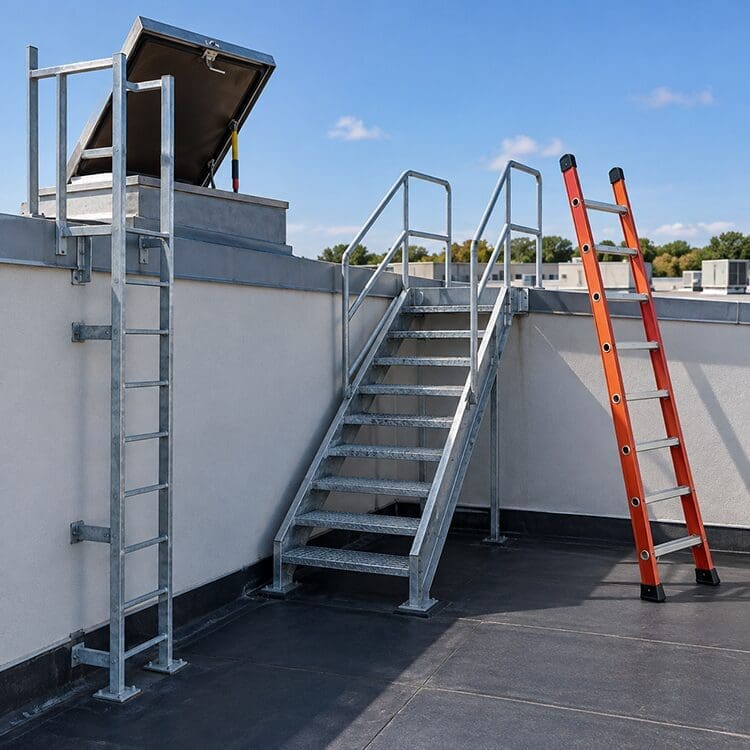
Commercial roofs can be reached through roof hatches, fixed ladders, stairs, portable ladders, exterior wall access, and other building-specific arrangements. These methods should not be treated as interchangeable simply because each ultimately gets someone onto the roof.
A roof hatch with an interior fixed ladder, for example, creates a transition from vertical climbing to the rooftop walking surface. OSHA’s general-industry ladder standard contains specific requirements for fixed ladders terminating at hatches, including clearance for access and hatch opening requirements. It also establishes requirements for ladder extensions, grab bars, clearances, and other ladder configurations.
A portable exterior ladder creates a different transition. OSHA requires a portable ladder used to access an upper landing surface to have side rails extending at least 3 feet above the upper landing surface, unless an alternative provision in the standard is used.
Fixed ladder height also matters. Under OSHA’s general-industry rules, fixed ladders extending more than 24 feet above a lower level are subject to specific fall protection provisions. New fixed ladders installed on or after November 19, 2018 that extend more than 24 feet must be equipped with a personal fall arrest system or ladder safety system, while the rule contains separate provisions and transition dates for older ladders.
For an owner, the practical lesson is not to memorize every ladder dimension. It is to recognize that the access system itself deserves evaluation.
Roof Edges Are Only One Part of the Fall Hazard
An obvious question is how close someone will be to the perimeter of the roof. But that is not the only condition we look at when thinking about roof access.
Potential fall exposure can also involve roof openings, hatches, changes in elevation, ladder transitions, unprotected sides, and the route between an access point and the equipment being serviced. OSHA separately addresses holes and openings, including criteria for guardrails and covers used to protect them.
That makes the travel path important.
Imagine two buildings with identical rooftop HVAC equipment. On the one building, the roof hatch opens well inside the roof and the equipment sits along a relatively direct interior route. On the other, workers emerge near an exposed edge and must travel along the perimeter to reach the equipment.
The equipment may be identical, but the access conditions are not.
Distance From a Low-Slope Roof Edge Can Change the Fall Protection Approach
OSHA’s general-industry rules provide a useful example of why we avoid blanket statements about commercial roof fall protection.
For work performed on a low-slope roof, OSHA’s rules distinguish among work performed less than 6 feet from the edge, 6 feet to less than 15 feet from the edge, and 15 feet or more from the edge. The permitted fall protection approaches vary within those zones and can also depend on whether work is temporary and infrequent. OSHA defines a low-slope roof for these provisions as a roof having a slope less than or equal to 4 in 12.

For example, OSHA has specifically addressed a scenario involving an HVAC technician accessing a 12-foot-high low-slope roof by portable ladder and walking to equipment located 25 feet from the roof edge. OSHA explained that its standards did not specifically require fall protection simply while the employee stepped from the ladder onto the roof and walked directly to that work area. Requirements while performing the work depended on the conditions addressed by the applicable standard.
That example illustrates an important point for owners:
Distance from the edge matters, but distance alone does not answer every fall protection question.
The type, frequency, duration, and location of the work matter too.
Readers looking for a broader regulatory discussion can review our article on roof safety regulations in Michigan. Specific compliance questions should be evaluated against the current standards and actual working conditions rather than relying on a general roofing article.
Why Rooftop Equipment Location Matters
HVAC units are one of the clearest examples of why roof layout becomes an access issue.
A unit that requires regular service effectively creates a recurring destination on the roof. That means we should consider not only the equipment itself but the route technicians will repeatedly use to reach it.
Questions worth asking include:
| Access consideration | Why an owner should notice it |
| Distance from access point to equipment | Determines how much rooftop travel is required |
| Distance from equipment to roof edge | May affect the hazards and protection methods associated with servicing it |
| Openings or elevation changes along route | Can introduce additional fall exposure |
| Frequency of equipment service | Turns an occasional route into a repeatedly traveled area |
| Condition of travel surface | Affects both access planning and roof protection |
| Multiple equipment locations | May create several travel routes rather than one predictable path |
Our article about roof penetrations and rooftop equipment addresses what equipment, curbs, and penetrations mean for the roofing system itself. The additional question here is how technicians safely reach and work around that equipment.
That distinction becomes especially important when equipment is being added or relocated.

Commercial Roof Fall Protection Is Not One Piece of Equipment
Building owners sometimes hear “fall protection” and picture a harness. That is too narrow.
Depending on the applicable standard, work, location, and conditions, fall protection approaches can include guardrail systems, safety net systems, personal fall arrest systems, travel restraint systems, and designated areas. OSHA’s general-industry low-slope roof provisions specifically change the available approaches according to distance from the roof edge and whether work is temporary and infrequent.
A designated area is also more specific than simply telling workers to remain away from the edge. OSHA establishes criteria for designated-area warning lines, including their location and construction. For applicable work, those lines may be positioned at least 6 feet from an edge for temporary and infrequent work or at least 15 feet from the edge for other work covered by the designated-area provision.
This is why we would not look at a roof plan and automatically prescribe one fall protection system.
The conditions need to be understood first.
If your building has an older access arrangement, frequently serviced rooftop equipment, uncertain travel paths, or significant changes since the roof was originally configured, those conditions can be documented as part of a commercial roof inspection. From there, the appropriate safety or compliance professionals can address requirements that extend beyond the roofing system.
Managing Roof Access by Maintenance Personnel and Other Trades
A roofing contractor may visit a building only periodically. Other trades may be on the roof much more often.
That makes access management part of protecting both people and the roofing system.
Building owners and facility managers can benefit from knowing who is accessing the roof, why they are going up, where they are working, and whether the work will introduce tools, equipment, materials, or unusual traffic.
We identify rooftop traffic as a distinct commercial roof maintenance topic and specifically identify service paths, punctures, dropped tools, maintenance contractors, and walk pads as issues worth addressing. Duro-Last®‘s maintenance guidance similarly calls for observation of unusual traffic and other changing roof conditions during maintenance inspections.
A simple owner-level roof access record can document:
- who accessed the roof and when
- the purpose of the visit
- the equipment or area serviced
- whether materials or equipment were brought onto the roof
- whether new equipment or penetrations were added
- whether anything unusual was observed
- whether roofing work may be necessary after another trade finishes
That record does not replace an employer’s safety responsibilities. It gives the building owner better visibility into what is happening on an asset that may otherwise receive little attention between roofing inspections.
Walk Pads and Designated Travel Paths Serve a Different Purpose
It is important not to confuse a roof traffic path with a fall protection system.

Walk pads or designated service routes can help organize recurring travel across appropriate areas of the roof and protect the roofing surface from concentrated foot traffic where compatible with the roof system. They do not, by themselves, establish that a worker is protected from a fall hazard.
This distinction matters because the two objectives can work together while remaining technically different.
A facility might have a clearly defined travel route between a hatch and several HVAC units. That route can help keep repeated traffic predictable. Whether additional fall protection measures are required is a separate determination based on the actual work and conditions.
When we inspect a roof that receives significant service traffic, we want to understand where people actually walk, not merely where the original plans assumed they would walk.
Adding Rooftop Equipment Can Change More Than the Roof
Suppose an owner adds a new HVAC unit, exhaust system, communications equipment, or another rooftop component.
From a roofing perspective, the project may affect penetrations, curbs, flashing, drainage, membrane protection, or warranty considerations. From an access perspective, it may also create a new work destination.
That means an owner should ask before installation:
How will someone service this equipment five years from now?
If the new unit is placed near an edge, across an elevation change, or far from the existing access point, the servicing route may introduce considerations that did not exist when the building’s original rooftop layout was established.
The same principle applies when equipment is relocated. Removing one unit and placing another somewhere else can change the travel pattern even when the total number of rooftop units remains unchanged.
Roof access should therefore be part of equipment planning, not an afterthought once installation is complete.
When Should Existing Commercial Roof Access Be Professionally Evaluated?
An owner does not need to wait for a roofing replacement project to examine access conditions.
We would consider an evaluation particularly worthwhile when:
- The building has an older fixed ladder or roof hatch. Existing conditions may predate current equipment, building use, or access patterns.
- Workers regularly service equipment near a roof edge. Frequent work deserves closer attention than an area almost never visited.
- The route from the access point to equipment is unclear or indirect. Actual worker behavior may differ from the intended path.
- New rooftop equipment is being installed or relocated. The modification may change where workers travel and perform service.
- There are roof openings or significant elevation changes along service routes.
- Different trades access the roof without a coordinated access process.
- Repeated traffic is visibly concentrated in particular areas of the roofing system.
- The owner cannot clearly describe how people are expected to reach and service rooftop equipment.
A roofing evaluation can document the roof surface, access locations, traffic patterns, equipment layout, and roof conditions. Fall protection system design, OSHA compliance, structural questions, and other regulated issues may require input from the employer, safety professional, design professional, equipment manufacturer, or other qualified party depending on the circumstances.
That division of responsibility matters. We can help an owner understand the roof and identify conditions that deserve attention without pretending that a roofing contractor or blog article replaces the professionals responsible for a project’s specific regulatory decisions.
Think About the Route, Not Just the Roof

One of the most useful ways for a building owner to think about commercial roof fall protection is to imagine the complete trip a worker makes.
Start inside or outside the building where access begins. Follow the ladder, stairs, or hatch onto the roof. Then follow the worker’s likely path to the HVAC unit, drain, exhaust fan, electrical equipment, or other destination.
Look at what happens along that entire route.
Where are the edges? Where are the openings? Are there elevation changes? Is there a predictable travel path? Does the worker have to carry equipment? How often is the destination serviced? Has the rooftop layout changed since the access system was installed?
Those questions reveal much more than simply asking whether the building “has roof access.”
If you are unsure whether your existing access arrangement, rooftop traffic patterns, or equipment layout should receive closer attention, schedule a commercial roof condition and access evaluation with our team. We can document the roofing conditions and access-related concerns so you have better information for the next decisions involving your facility.
Frequently Asked Questions
Not necessarily. Applicable requirements depend on the work being performed, who is performing it, the walking-working surface, distance from lower levels or roof edges, and other conditions. OSHA’s general-industry low-slope roof provisions, for example, provide different requirements according to distance from the edge and whether work is temporary and infrequent.
There is no single number that should be applied to every commercial rooftop situation without identifying the applicable OSHA standard and work activity. Under OSHA’s general-industry walking-working surface rules, employees on walking-working surfaces with an unprotected side or edge 4 feet or more above a lower level generally require protection, subject to the detailed provisions and exceptions in the standard. Low-slope roof work also has specific distance-based provisions.
There is not one universal OSHA equipment-placement distance that answers this question for every building. The equipment’s location affects where servicing work occurs, and OSHA’s low-slope roof provisions distinguish work performed less than 6 feet, 6 to less than 15 feet, and 15 feet or more from an edge. Equipment placement should therefore be evaluated with the actual servicing activity and applicable requirements in mind.
Walk pads should not be assumed to satisfy fall protection requirements simply because they identify a route. Their roofing purpose is different from systems such as guardrails, personal fall arrest systems, travel restraint systems, or OSHA-compliant designated areas. The appropriate fall protection approach depends on the work and conditions.
OSHA has specific provisions for fixed ladders extending more than 24 feet above a lower level. New fixed ladders installed on or after November 19, 2018 that meet that condition require a personal fall arrest system or ladder safety system, while existing ladders and replacements are subject to additional provisions and transition requirements.
Yes, the access implications are worth evaluating. New equipment can create a new service destination and change where technicians travel and work, even if the existing roof hatch or ladder does not change.
That depends on the issue being evaluated. Employers have responsibilities under OSHA standards, while building design, structural conditions, local code requirements, equipment design, and fall protection system design can involve other qualified professionals or authorities. A roofing contractor can help document roof and access conditions, but owners should not treat a roofing assessment as legal or regulatory-compliance advice.